Before getting into the Cleric specifically, it’s worth explaining how heroes grow in DarkVael.
Every hero has 5 levels. At each level, they gain access to new Hero Ability Cards, but players still decide how they want that hero to develop. Do you add more ability cards and widen your tactical options? Do you improve your hero’s core stats? Do you stay flexible and take a bit of both?
The intent is that two players using the same hero might not end up with the same build.
One of the important stats is stamina. Stamina refreshes every round, so it is not something you save over the course of the adventure. Instead, it defines what kind of turn your hero can afford right now. Stronger abilities usually cost more stamina, and increasing your max stamina through level-ups, items, or power-ups lets you build bigger turns and combine more powerful cards. You might have the perfect cards in hand, but your stamina limit still forces a choice: what can you actually fit into this turn?
That’s the broader hero framework: growth through choices, and combat turns shaped by stamina, timing, and risk.
The first hero we’re showing is the Cleric.
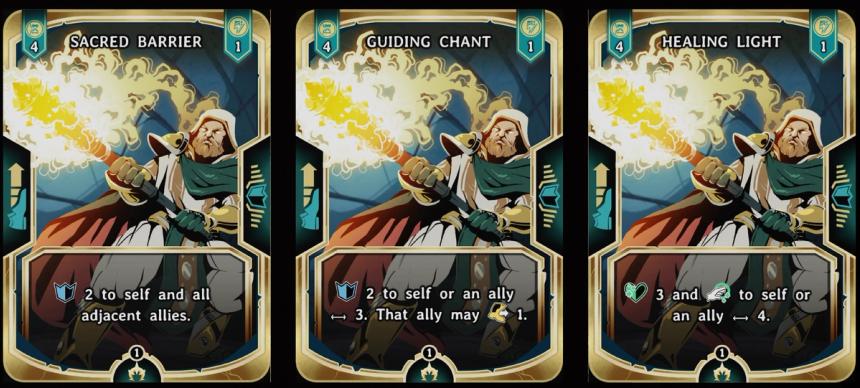
The Cleric is the party’s sacred support hero, but he is not a fragile back-line healer. He is built to stand closer to danger, protect allies, and punish undead enemies with holy attacks. His ability cards help the party survive pressure, recover from bad turns, and hold the line when the dungeon starts pushing back.
He can heal and protect, but we didn’t want him to feel like someone who only reacts after damage has already happened. The Cleric should be able to prepare the party, absorb pressure, and create moments where the group can survive a turn that might otherwise collapse.
But the part that really defines the Cleric is his Bless system.
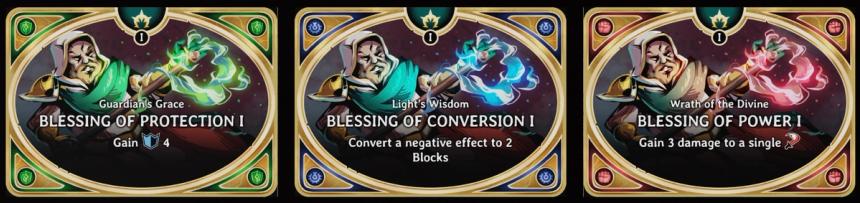
Shown here are just a few of the Blesses available to the Cleric. Bless cards come from a rotating 3-card market, so the Cleric is constantly deciding which sacred tools are worth taking, who should receive them, and when they should be spent.
The Cleric can give a Bless to another hero, or keep it for himself.
Each Bless can be used at any time, but only twice.
The first time a Bless is used, it flips into a stronger version.
The second time it is used, it is extinguished and leaves play.
That creates a small but important question every time a Bless is handed out:
Who should carry this?
When should they use it?
Is this the moment to spend it, or do we hold it for something worse?
One of the design challenges with support heroes is that they can easily become too passive. If the Cleric only reacts after someone takes damage, the player spends most of the game waiting for problems to happen.
We wanted the Cleric to feel more proactive.
Blesses are our answer to that. They let the Cleric prepare the party before the worst moment arrives, but without making the choice automatic. A Bless is powerful, but temporary. Once it is given out, the question shifts to the whole table: who is carrying it, when should it be used, and is this threat worth spending it on?
For example, a defensive Bless might seem obvious on the Paladin, but maybe the Rogue needs it more because they are about to commit to a risky combo turn. A damage-focused Bless might help the Mage create a huge spell turn, but holding it too long could mean losing tempo while the dungeon keeps applying pressure.
That’s the support role we’re aiming for with the Cleric: not a passive healer, and not a generic buffer, but a battle-priest who can hold the line, strike back against the undead, and prepare the party with limited blessings and wards.
When the Cleric is working well, his blessings should feel like the thin line between survival and collapse.